• Red and green luster dust on sugar cookies is the fastest way to make your holiday baking look genuinely impressive
• Gold on dark chocolate and silver on white frosting — these two combinations hit every time
• A dry brush gives you control; wet mixing gives you intensity. Know which one you need before you start
• White luster dust isn’t just filler — on snowy scene cakes and meringues, it’s the whole look
Holiday Baking with Edible Glitter: Christmas & Beyond
December is the one month where you can go completely over the top with edible glitter for cakes and cookies and nobody will say a word. The bar is already high. Everyone’s already expecting something spectacular. Use that.
Here’s what actually works — not just theoretically, but in practice, on real holiday bakes, under kitchen lighting that isn’t a professional photo studio.
The Colors That Actually Matter for the Holidays
You don’t need every color. You need the right ones. For Christmas, four colors cover almost everything: red, green, gold, and silver. White earns a spot if you’re doing winter-themed work. Blue comes in for Hanukkah and those icy winter wonderland cakes that are genuinely stunning when done right.
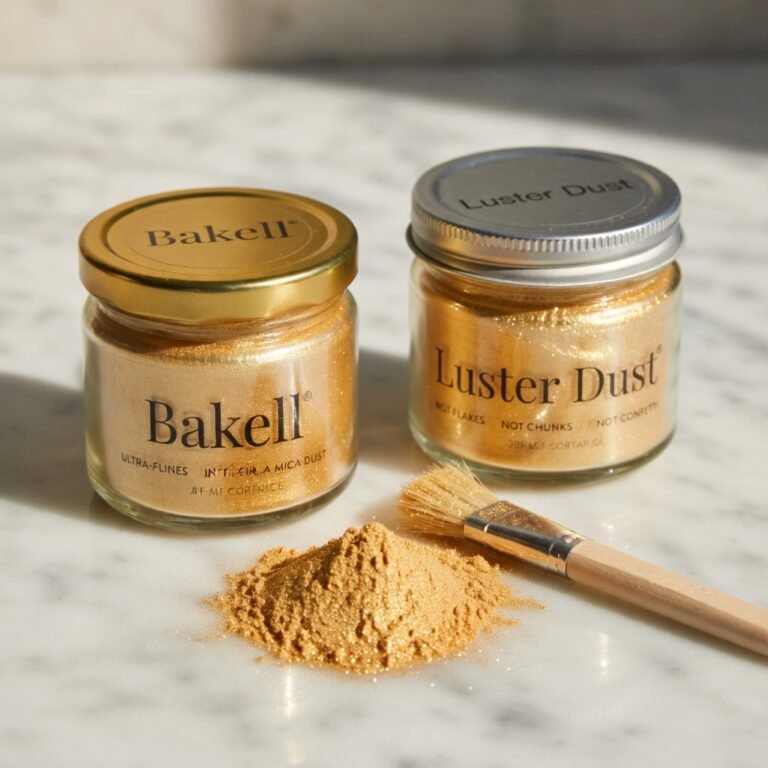
Red Luster Dust is the workhorse of holiday baking. Deep, rich, catches light beautifully on both light and dark surfaces. Green Luster Dust runs a close second — especially on fondant decorations like holly leaves, where the shimmer makes them look almost three-dimensional. Gold Luster Dust goes on basically everything. And Silver Luster Dust is criminally underused in holiday baking — more on that in a minute.
Sugar Cookies: The Highest-Impact Application
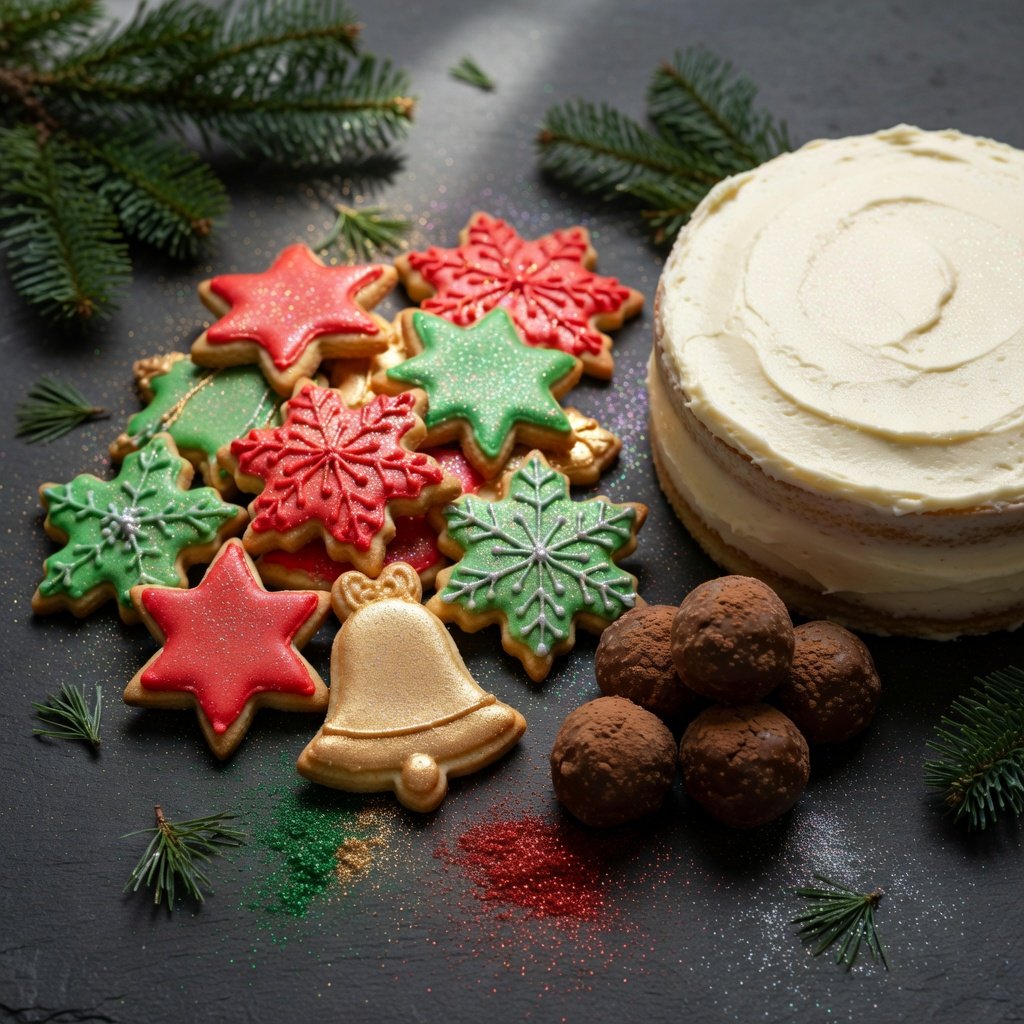
If you’re only doing one thing with edible cookie glitter this holiday season, make it this: dust luster dust directly over royal icing before it fully sets. Not wet, not bone dry. That in-between stage — tacky but not sticky — is the sweet spot. The glitter adheres evenly and the color comes out vivid.
Red on a white-iced stocking. Green on a Christmas tree. Gold on a star. You can do all of these with one brush and three jars, and your cookies will look like they came from a bakery that charges $5 each. The technique takes about 30 seconds per cookie once you get the hang of it.
One thing people get wrong: they wait until the icing is completely dry and then wonder why the glitter won’t stick. Dry icing needs a different approach — either dust immediately (while wet, which can cause bleeding), hit that tacky window, or use a tiny amount of clear extract on a brush to press the glitter into set icing. The last method works, but it takes longer. The tacky window is just easier.
For more on technique — dusting vs. painting vs. mixing into frosting — the full breakdown is in our guide to using edible glitter on cakes, cupcakes, and cookies. Worth reading before you start a big holiday batch.
Cakes: Go Big or Go Subtle — Both Work
Holiday cakes fall into two camps. The first is bold and maximalist: dramatic tiers, lots of color, the kind of cake that gets photographed and shared. The second is quietly elegant: simple flavors, restrained decoration, where the glitter is a finishing touch rather than the whole statement. Luster dust is perfect for both.
For bold cakes: Red and green dusted onto white buttercream creates a holiday palette that looks intentional and polished. Try dusting in sections rather than all over — a stripe of red on one side, green on the other, gold on the top edge where they meet. The contrast is really good.
For elegant cakes: Gold on a naked cake with exposed layers is quietly stunning. Just a light dusting on the top and edges. Same with silver on a smooth white fondant finish — it picks up the light differently depending on the angle, which is the whole point of mica-based glitter. It moves. Flat paint doesn’t do that.
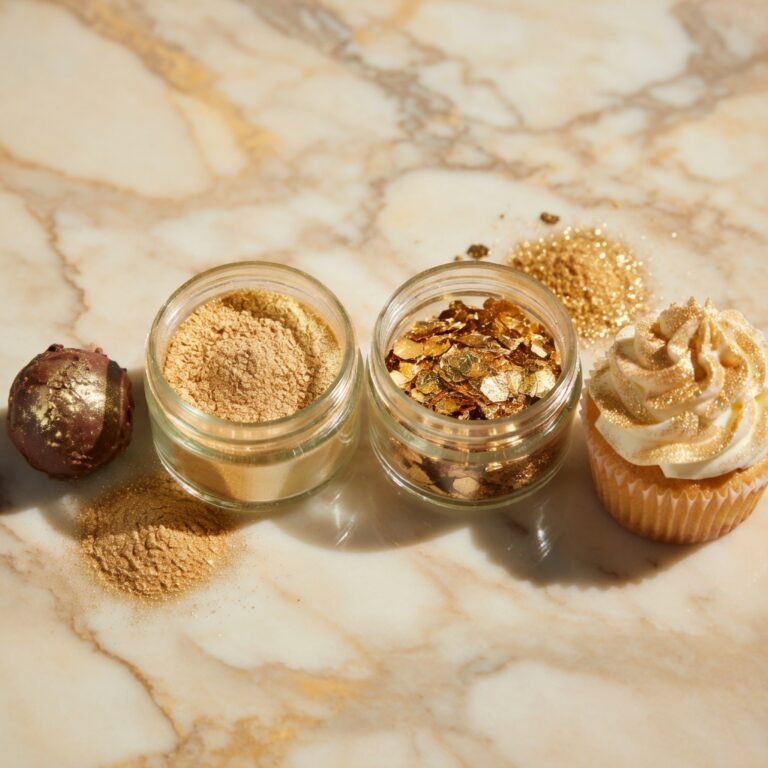
Dark chocolate cakes deserve special mention. Gold Luster Dust on a dark chocolate ganache finish looks genuinely expensive. Silver on dark chocolate is even better — the contrast is sharper. We tested both at different times and the silver version consistently gets more comments. It looks like something from a high-end patisserie.
The Silver Conversation
Silver gets overlooked every holiday season and it shouldn’t. Silver Luster Dust on white or ivory buttercream creates this cool, icy effect that’s perfect for winter-themed cakes. Snowflake cookies dusted in silver look better than the same cookies in white. Chocolate truffles with a thin brush of silver look like they cost $15 each.
Also: silver and gold together. Not evenly mixed — layered. A base dusting of gold with silver brushed lightly over the top catches light at different angles and gives you depth that neither color achieves alone. Try it on the top of a Yule log cake. You’ll use that trick forever.
White Luster Dust: The Underdog of Holiday Baking
White Luster Dust looks subtle in the jar. On the right surface, it’s anything but. Dust it over white royal icing and you get this fresh-snow shimmer that’s genuinely beautiful. Brush it onto meringue mushrooms and they look like they grew in an actual forest. Use it on a snowy scene cake and suddenly those fondant drifts have depth instead of just looking like white frosting.
The key is surface contrast. White on white doesn’t disappear — the pearlescent quality of the mica still creates shimmer — but it’s subtle. White on a light blue fondant pops more. White on dark surfaces creates a frost effect. Know what you’re going for before you start.
Hanukkah and Winter Cakes: Blue and Silver
Blue luster dust is genuinely beautiful on white or cream backgrounds. Blue Luster Dust combined with silver creates a color palette that works for Hanukkah but also just for any winter-themed bake where the warm red-and-green Christmas palette doesn’t fit.
Blue dusted sugar cookies with silver stars. A white layer cake with blue and silver gradient brushwork on the outside. Blue and white marbled fondant accents with a silver shimmer. These combinations photograph beautifully and taste exactly the same as everything else — which is the whole point. Luster dust is completely tasteless. It’s all visual.
Practical Tips for Holiday Baking Season
A few things that save time when you’re in the middle of a big baking push:
- Use a dedicated brush for each color. Cross-contamination ruins reds (they go muddy) and silvers (they go greenish). Label your brushes or get different sizes for different colors so you know which is which.
- Start with less than you think you need. 1/8 teaspoon covers more surface area than you’d expect. You can always add more; you can’t take it back.
- Work with a clean, dry brush for dusting. If you’re painting (mixing with extract or alcohol), use a smaller, stiffer brush for control.
- For large batches of cookies, set up a station: icing first, then glitter dusting as each cookie hits that tacky stage. Don’t try to glitter ice-cold fully-set cookies — you’ll fight it the whole time.
What Not to Do
Honestly, the biggest mistake in holiday baking with edible glitter is overdoing every single element. Glitter works best as contrast. If every surface of a cake is coated in heavy glitter, the eye doesn’t know where to land. Pick your moments.
The second mistake is using craft glitter because “it looks the same.” It doesn’t taste the same. It’s not food. If a product says “non-toxic” rather than “edible” or “FDA compliant,” it should not be in food — full stop. Everything in our line is made with FDA-compliant mica pigments, vegan, gluten-free, completely tasteless. That’s the baseline you should expect from anything you put on a cake.
The Combinations Worth Remembering
After a lot of holiday baking, these are the pairings that consistently deliver:
- Red on white buttercream. Classic. Vivid. Exactly what you think it is, and it works.
- Gold on dark chocolate ganache. Looks expensive. Requires almost no effort.
- Silver on white fondant. Icy, elegant, gets more comments than you’d expect.
- Green on ivory buttercream. Warmer than green on white. More sophisticated feel.
- Blue and silver together on anything white. Winter and Hanukkah in one palette.
- White on meringue. Transforms something simple into something beautiful.
The holidays are already a lot. Luster dust is one of the few baking upgrades that takes almost no time and makes a disproportionate difference. A 10-second dust on a finished cookie changes the whole look. Trust that.
Yes — and it works really well with buttercream. Mix a small amount (start with 1/8 teaspoon per cup of frosting) until evenly distributed. The whole frosting takes on a pearlescent shimmer. Gold and rose gold are particularly good this way. Avoid over-mixing; you want to incorporate it, not beat the shimmer out of it.
For cookies, a 10g jar will cover 4-6 dozen cookies with a standard dusting — easily enough for a full holiday batch. For cakes, it depends on coverage, but a 10g jar handles most single-tier cakes with room to spare. If you’re doing a large multi-tier or want heavy coverage, go with a 25g jar to be safe.
Nothing. Completely neutral. Mica-based luster dust is tasteless and odorless — it doesn’t affect flavor at all. Your cookies taste exactly like your cookies. The glitter is purely visual.
Use a wide, soft brush and work in light layers. Dust from about 6 inches above the surface for broader, more even distribution. Don’t tap the brush directly on the cake — you’ll get concentrated spots. Build up gradually rather than trying to get full coverage in one pass.
You Might Also Like
How to Use Edible Glitter on Cakes, Cupcakes & Cookies
Dry brushing, wet painting, mixing into frosting — the full technique breakdown for every application.
Is Edible Glitter Actually Safe? Everything You Need to Know
The difference between 'non-toxic' and 'edible,' and why it matters for every bake.
Edible Luster Dust for Beginners: Your First Project Guide
Starting from zero? This is where to start.