- Gold luster dust is FDA compliant, made from food-grade German mica pigments — it’s actual food, not craft glitter
- Works on cakes, cookies, chocolate, and drinks — the shimmer behaves differently on each surface, and that’s a good thing
- A little goes a long way — most people use too much, which kills the effect
- Gold outsells every other color we carry by a wide margin. There’s a reason for that.
Gold outsells every other color we carry by 3x. And honestly, it’s not even close. Every other month someone asks us what the “best” luster dust is — and while that depends on the project, gold is almost always the answer. It’s warm, versatile, and the way it catches light is just different from every other color.
Here’s everything you need to know about using it well.
What Gold Luster Dust Actually Is
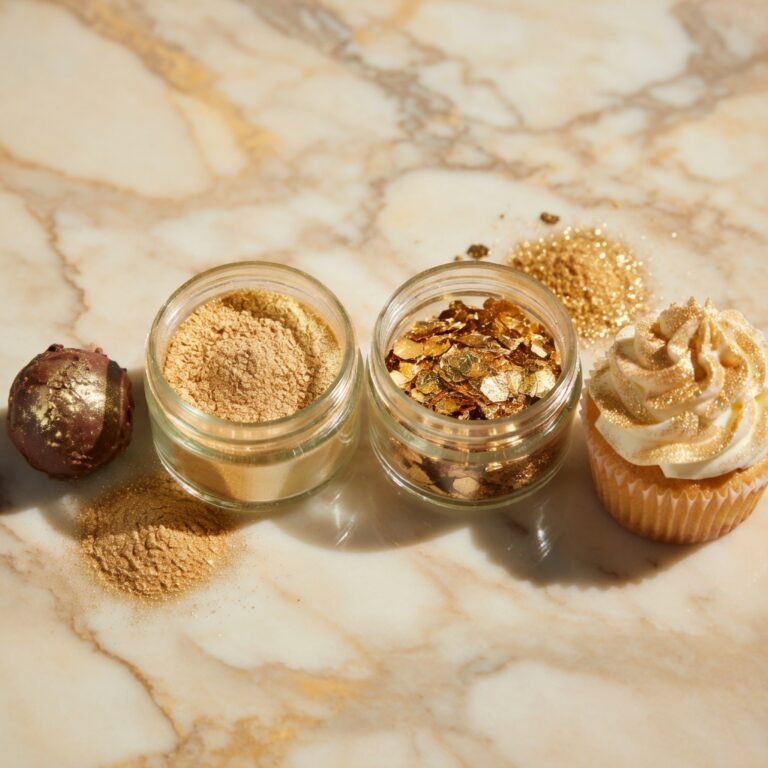
It’s a fine, pearlescent powder made from mica — the same mineral-based pigment that’s been used in food products for decades. Ours comes from Germany, which matters because the particle quality directly affects the shimmer. Cheap mica looks flat. Good mica looks dimensional, like actual metallic gold.
All of our luster dust is FDA compliant, vegan, gluten-free, and completely tasteless. You’re not adding flavor when you use it — just light. Gold Luster Dust is the one we’d start with if you’ve never used luster dust before. It’s a warm, deep gold — not yellow, not bronze, but that specific rich tone that reads as genuinely metallic.
What You Can Put It On
Short answer: almost everything. But the shimmer behaves differently depending on surface texture, so it’s worth knowing what to expect.
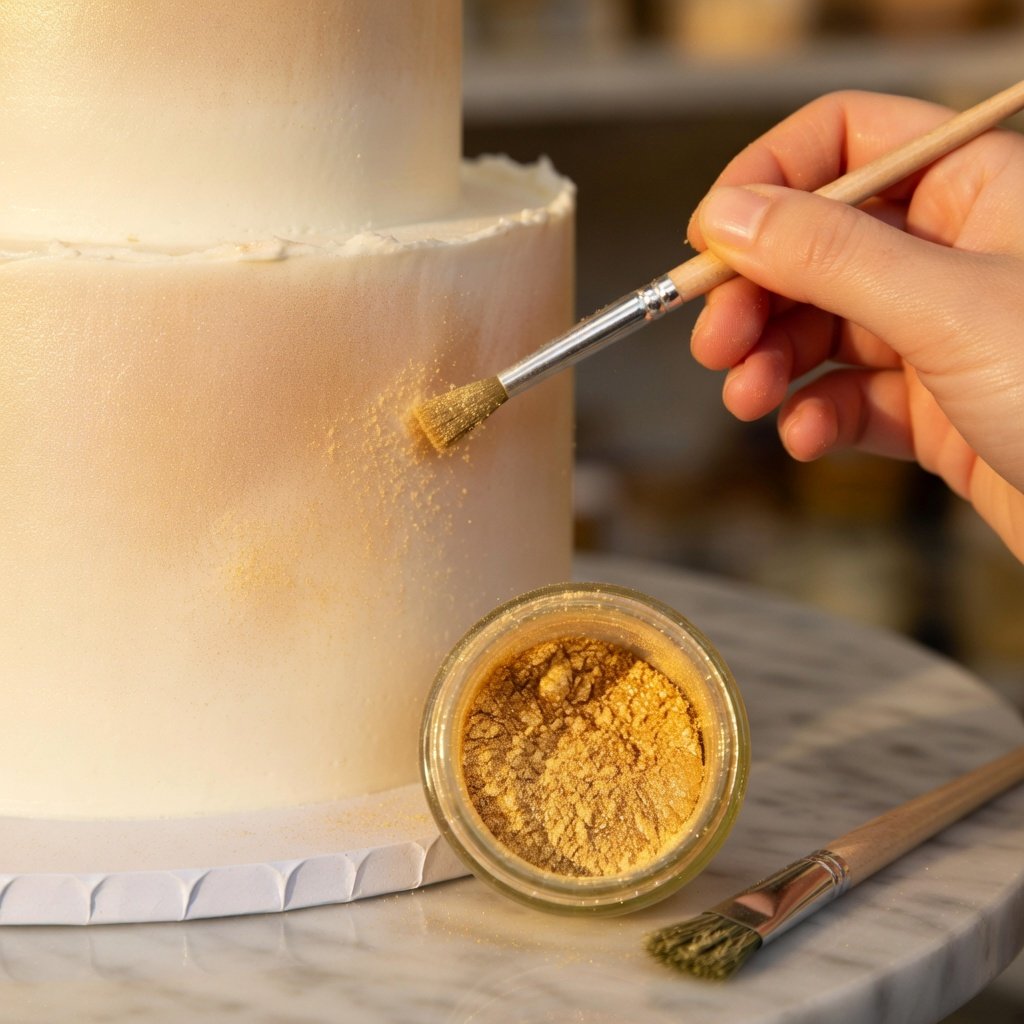
Fondant is where gold luster dust really performs. The smooth, slightly matte surface lets the shimmer sit on top rather than sinking in, and the result looks like actual gold leaf — without the $40 sheet of gold leaf.
For application, use a dry brush. Pick up a small amount of dust on a clean food-safe brush and lightly sweep it over the surface. Build it up in layers rather than trying to load too much at once. One pass gives you a subtle glow. Two or three passes gives you full metallic coverage.
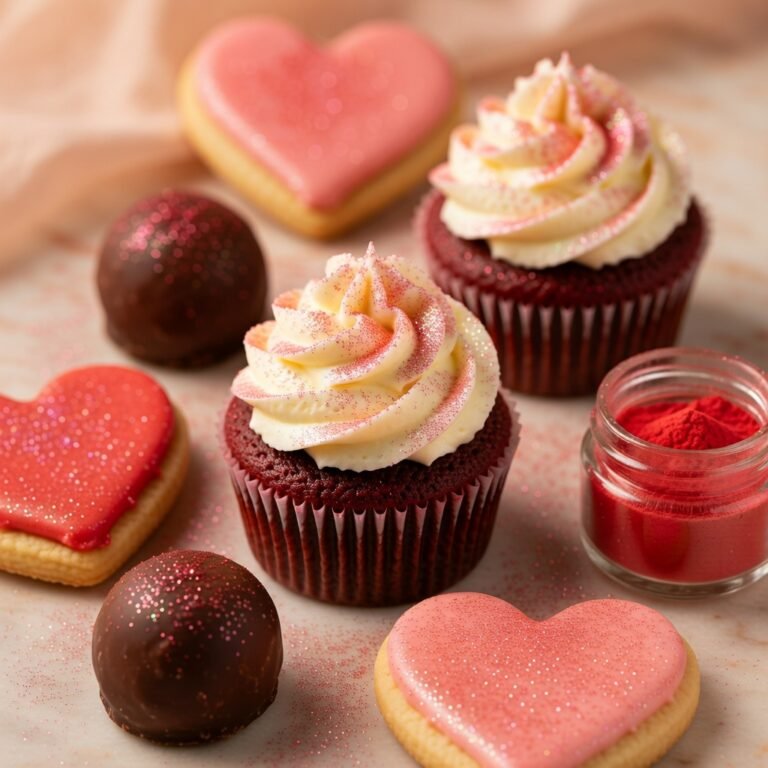
Buttercream works too, though the texture is less smooth so the effect is softer — more of a warm shimmer than a sharp metallic. That’s not a bad thing; it just looks different. Check out our full guide on how to use edible glitter on cakes, cupcakes, and cookies if you want the deeper breakdown.
Gold on royal icing is one of the cleanest-looking applications there is. The hard, flat surface gives you sharp metallic definition — perfect for geometric designs, holiday cookies, anything you want to look elevated.
Two methods work best. Dry brushing over fully hardened royal icing gives you a consistent metallic sheen across the whole surface. Or mix a tiny amount of gold luster dust with a drop of lemon extract or clear alcohol to create a paint — that lets you get into fine detail work without a stray particle going where it shouldn’t.
Sugar cookies with buttercream can work too, but the finish is softer. If you want sharp metallic, stick to royal icing.
Dark chocolate and gold is one of those combinations that always looks expensive. The deep brown surface makes the gold pop in a way it doesn’t on lighter backgrounds.
For molded chocolates, dust the mold lightly before pouring the chocolate — the gold ends up on the outside of the finished piece, perfectly placed. For truffles, just brush or roll them after they’ve set. Takes about 30 seconds per piece and adds what feels like $5 of perceived value.
Silver Luster Dust works just as well on dark chocolate if you want something with a different feel — cooler, more modern. But gold is the classic.
Drop a small pinch of gold luster dust into a glass of champagne or prosecco and watch what happens. The particles catch the light as they move through the liquid — it’s not sparkle exactly, more like the glass itself is glowing. Our Gold Shimmer Champagne Cocktail is the easiest version of this and takes maybe 30 seconds.
The key: don’t overdo it. A pinch — the smallest amount you can pick up between two fingers — is enough for one glass. Too much and the drink goes cloudy. The shimmer effect comes from the particles moving through the liquid, not from saturating it.
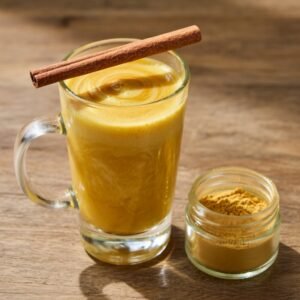
It also works in warm drinks. Our Golden Turmeric Shimmer Latte uses gold dust in a way that actually complements the flavor profile — the warm tones of turmeric and the warm metallic of gold are a natural match.
Gold vs. Rose Gold vs. Silver — Which One?
Gold is the default for a reason. Warm tones, works on almost anything, reads as “celebration” in basically any context. But there are times when the others are the right call.
Rose Gold Luster Dust is what we’d reach for on pink or white desserts, or anything with a romantic or modern aesthetic. It’s a softer, warmer pink-gold tone — beautiful on macarons, stunning in prosecco, really nice on buttercream. The Rose Gold Prosecco Spritz shows off what that color does in a glass.
Silver Luster Dust is the move for dark desserts, anything modern or minimalist, or when you want “expensive-looking” over “celebratory.” Silver on dark chocolate truffles looks like something from a high-end patisserie. Gold on the same truffle looks festive. Different goals.
The shortcut: gold for warm tones and celebrations, rose gold for soft and romantic, silver for dark desserts and anything you want to look sharp.
How Much to Use
This is where most people go wrong. Luster dust is concentrated. A 10g jar contains somewhere between 80 and 100 uses for drinks, and even for cake decorating it lasts longer than you’d expect. The instinct is to load up the brush or dump a bunch in the drink — don’t. Start with less than you think you need, then add more if you want.
For drinks: 1/8 teaspoon per glass, maximum. For cakes: build layers gradually with a dry brush. For cookies: one light pass over royal icing, then decide if you want more.
Dry Brush vs. Wet Application
Dry brushing is the faster, more forgiving method. Pick up dust on a clean brush, tap off the excess, apply in light sweeping motions. Good for large surfaces, backgrounds, any time you want overall metallic coverage.
Wet application — mixing luster dust with a small amount of clear alcohol or lemon extract — gives you more control and a deeper metallic finish. The liquid evaporates quickly and leaves the pigment behind. Use this method for detail work, hand-painting designs, or anywhere you need crisp edges. Vodka and lemon extract both work; they evaporate cleanly and don’t leave any taste.
Is Gold Luster Dust Safe?
Yes. Every color we sell is FDA compliant, made from mica-based pigments that have been used in food products for decades. Vegan, gluten-free, no GMOs, completely tasteless. If you want the full breakdown of what’s in it and how it’s regulated, we covered it in detail here.
One thing worth knowing: “non-toxic” and “edible” are not the same label. Non-toxic means it won’t hurt you. Edible means it’s approved for consumption. Our luster dust is edible. Some products on Amazon that call themselves edible glitter are only “non-toxic” — different standard, different ingredients. Read labels.
You can mix it into frosting — it works best in lighter-colored frostings where the metallic tone shows up. Mix sparingly and stir gently; aggressive mixing can break down the particles and dull the shimmer. Mixing it into batter before baking isn’t worth it — heat and submersion in wet batter kills the metallic effect. Apply after baking.
Longer than you’d think. A 10g jar gives you roughly 80-100 uses for drinks at 1/8 tsp per glass. For decorating, usage varies more by project, but most home bakers find a 10g jar lasts through dozens of projects. We also carry 50g and 1kg sizes if you go through it fast.
Luster dust is a fine powder that creates a metallic or pearlescent sheen — it’s about shimmer and glow, not visible sparkle. Edible glitter is coarser with visible flakes or larger particles. Both are edible; they just produce different effects. Luster dust looks more refined. Glitter looks more festive. Right tool for the job.
It does, but the contrast is different. On white or ivory fondant, gold really pops — the light tone underneath amplifies the metallic. On dark fondant, the effect is more subtle, like a sheen rather than full metallic coverage. If you want strong metallic on dark surfaces, try silver — the contrast reads cleaner.
Yes, and it looks great. The smooth, slightly glossy shell takes luster dust well. Dry brush over the top half of each macaron after they’ve fully set. You get a clean metallic line without any mess. Rose gold is actually our favorite on macarons if you want to try something a little different.