• Mirror glaze is easier than it looks — but temperature is everything. Pull it off the heat at 90–95°F and pour fast.
• Four luster dust colors working together: purple, blue, light blue, and silver create the galaxy depth.
• You need a chilled cake — straight from the freezer is best. The cold sets the glaze instantly as it hits.
• This recipe works on any smooth-frosted or fondant-covered cake. Round layers work best.
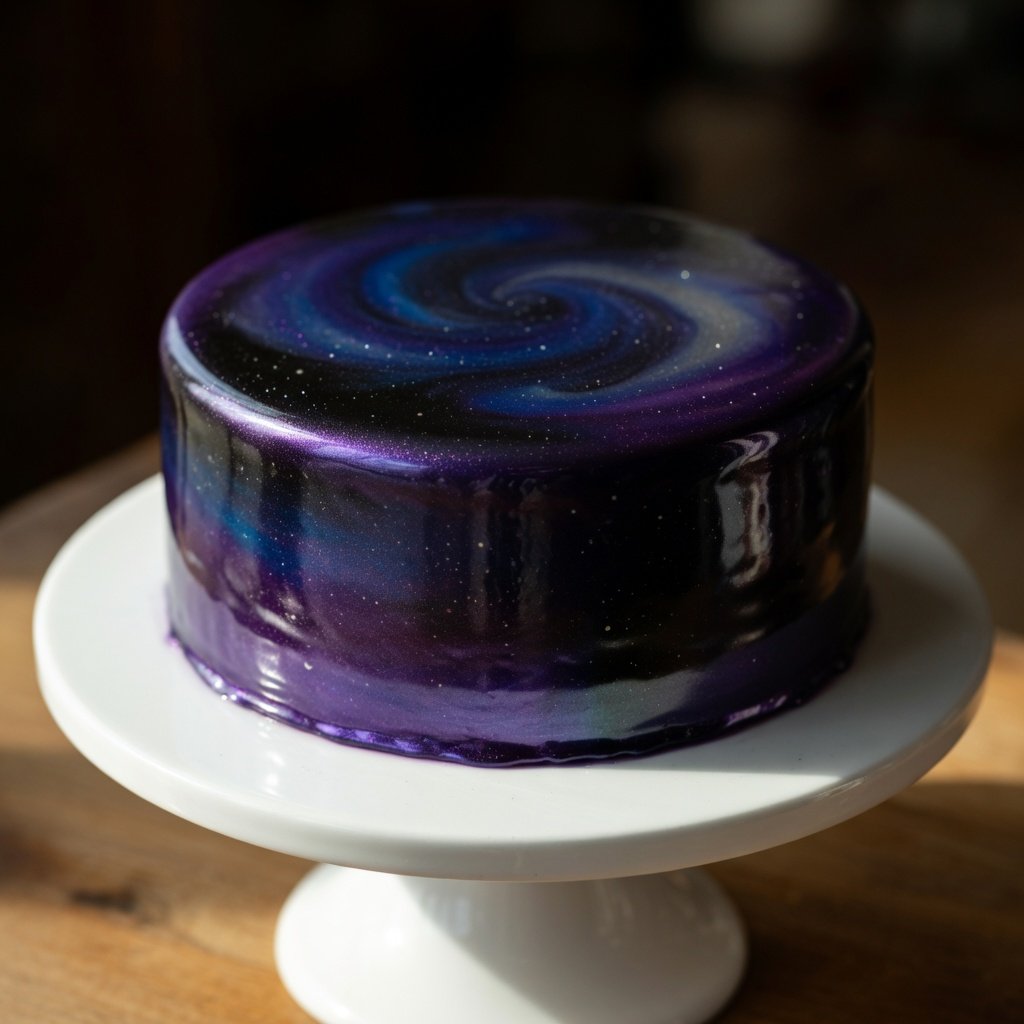
Mirror glaze looks like witchcraft. The galaxy version — with deep purples, blues, and a hit of silver — looks like someone poured the night sky over a cake. The glaze does most of the work. You just have to nail the pour.
Ingredients
- 1 batch White mirror glaze base (recipe below)
- 1 tsp Purple Luster Dust
- 3/4 tsp Blue Luster Dust
- 1/2 tsp Light Blue Luster Dust
- 1/2 tsp Silver Luster Dust
- 20 g Unflavored powdered gelatin
- 100 ml Cold water (for gelatin bloom)
- 300 g Granulated sugar
- 200 ml Heavy cream
- 150 ml Water
- 200 g White chocolate, finely chopped
- 2 tbsp Black gel food coloring
- 1 Chilled 6-inch cake, frozen solid (any flavor, smooth-frosted)
Sprinkle gelatin over 100ml cold water in a small bowl. Let it sit untouched for 5 minutes. It’ll look wrong. It’s not — that’s just blooming.
Combine sugar, heavy cream, and 150ml water in a saucepan over medium heat. Stir until sugar dissolves, then bring just to a simmer. Pull it off the heat immediately. Add the bloomed gelatin and stir until completely dissolved. Pour the hot mixture over your chopped white chocolate and let it sit for 2 minutes, then stir smooth. Add the black gel food coloring and mix well — you want a deep charcoal, not gray.
Divide the glaze into four portions: a large one (about half the total) and three smaller ones. Stir Purple Luster Dust into the large portion. Mix Blue Luster Dust into the second, Light Blue Luster Dust into the third, and Silver Luster Dust into the fourth. Stir each well — the mica pigments disperse completely into warm glaze.
Let all four glazes cool to 90–95°F, stirring gently every few minutes. Use a thermometer — this is the step people skip and then wonder why the glaze slid off. Too hot and it runs thin. Too cold and it sets before it can smooth out.
Place your frozen cake on a wire rack over a rimmed baking sheet. The cake needs to be cold enough that the glaze sets on contact — straight from the freezer, 30 minutes minimum.
Working fast, pour the purple base over the top of the cake first. Then drizzle the blue, light blue, and silver in loose swirls across the top and sides. Don’t over-mix — the swirl patterns will run and blend on their own as the glaze flows down. The silver catches light wherever it lands. Let the excess drip off completely before moving the cake, about 3–4 minutes.
Carefully slide the cake off the rack and onto your serving plate. Any drips at the base? Tuck them under with a small offset spatula. Refrigerate uncovered for at least 20 minutes before slicing. The glaze firms up into that signature mirror finish as it chills.
—
For a deeper look at how luster dust behaves on different cake surfaces, [our guide on using edible glitter on cakes](https://lusterdust.com/how-to-use-edible-glitter-on-cakes-cupcakes-cookies/) breaks it down color by color.
Almost always a temperature problem. Either the glaze was too warm when you poured, or the cake wasn’t cold enough. Mirror glaze needs that temperature contrast to set quickly on contact. Freeze the cake solid — not just refrigerator-cold — and check the glaze with a thermometer before pouring.
Yes. Make it up to 3 days ahead, press plastic wrap directly against the surface, and refrigerate. Rewarm in a double boiler or short microwave bursts, stirring constantly, until it hits 90–95°F again. Don’t rush it.
Pour faster and with more confidence. Hesitating lets each color set slightly before the next one lands, which kills the swirl. Pour all four in one quick sequence. Also try adding the silver last — dropped in thin streams from a higher angle, it creates the starburst effect without blending into the other colors.
You Might Also Like


[ld_schema_recipe]{
“@context”: “https://schema.org/”,
“@type”: “Recipe”,
“name”: “Galaxy Mirror Glaze Cake with Edible Glitter”,
“description”: “A deep-space mirror glaze cake made with purple, blue, light blue, and silver luster dust. Swirling galaxy colors pour over a frozen cake and set into a high-shine finish that looks like the night sky.”,
“image”: “https://lusterdust.com/wp-content/uploads/galaxy-mirror-glaze-cake.jpg”,
“author”: {
“@type”: “Organization”,
“name”: “Luster Dust”
},
“prepTime”: “PT45M”,
“cookTime”: “PT20M”,
“totalTime”: “PT65M”,
“recipeYield”: “12 servings”,
“recipeCategory”: “Dessert”,
“recipeCuisine”: “American”,
“keywords”: “cake with edible glitter, edible glitter for cakes, galaxy mirror glaze, mirror glaze cake, luster dust cake, edible glitter cake, galaxy cake”,
“recipeIngredient”: [
“1 tsp Purple Luster Dust”,
“3/4 tsp Blue Luster Dust”,
“1/2 tsp Light Blue Luster Dust”,
“1/2 tsp Silver Luster Dust”,
“20g unflavored powdered gelatin”,
“100ml cold water (for gelatin bloom)”,
“300g granulated sugar”,
“200ml heavy cream”,
“150ml water”,
“200g white chocolate, finely chopped”,
“2 tbsp black gel food coloring”,
“1 chilled 6-inch cake, frozen solid”
],
“recipeInstructions”: [
{
“@type”: “HowToStep”,
“name”: “Bloom the gelatin”,
“text”: “Sprinkle gelatin over 100ml cold water in a small bowl. Let it sit untouched for 5 minutes.”
},
{
“@type”: “HowToStep”,
“name”: “Make the base glaze”,
“text”: “Combine sugar, heavy cream, and 150ml water in a saucepan over medium heat. Stir until sugar dissolves, then bring just to a simmer. Remove from heat, add bloomed gelatin and stir until dissolved. Pour over chopped white chocolate, let sit 2 minutes, then stir smooth. Add black gel food coloring and mix to a deep charcoal.”
},
{
“@type”: “HowToStep”,
“name”: “Add the luster dust colors”,
“text”: “Divide the glaze into four portions. Stir Purple Luster Dust into the largest portion. Add Blue Luster Dust to the second, Light Blue Luster Dust to the third, and Silver Luster Dust to the fourth.”
},
{
“@type”: “HowToStep”,
“name”: “Temper to pouring temperature”,
“text”: “Cool all four glazes to 90–95°